
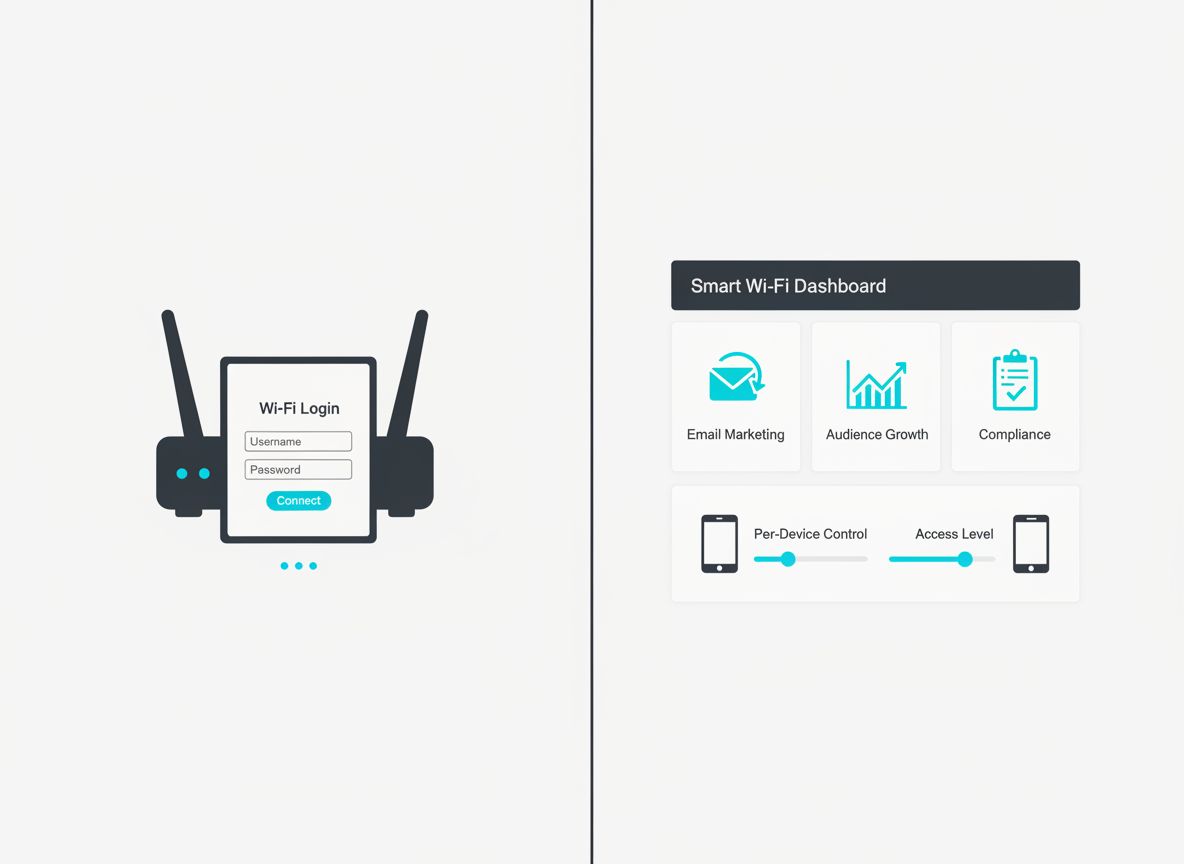
Guest Wi‑Fi is one of the few channels that touches almost everyone who walks into a venue. But in most businesses, Wi‑Fi is still treated like a utility: get people online, offer the amenity, move on.
That’s exactly what a standard, built-in captive portal is designed to do.
If you want Wi‑Fi to support growth—more repeat visits, bigger lists, better campaigns, clearer ROI—you need more than a login screen. You need Smart Wi‑Fi.
This article breaks down the difference in plain English for two audiences:
- Marketing teams who want measurable outcomes (not just “we offer free Wi‑Fi”).
- IT teams who worry that “marketing Wi‑Fi” means ripping and replacing hardware or creating a support nightmare.
The quick definition: captive portal vs Smart Wi‑Fi
A built-in captive portal is typically a basic splash page that appears before a guest gets internet access.
Smart Wi‑Fi uses that same moment—when a guest is already engaged—to help you:
- Capture usable customer data
- Trigger follow-up marketing
- Connect to your existing systems
- Apply smarter usage controls per device
- Document consent in a way that stands up to audits
- Report performance weekly and ROI monthly
What most built-in captive portals actually deliver
Most Wi‑Fi hardware includes a captive portal feature. It’s useful, but it’s limited.
Typical built-in portal capabilities:
- A simple splash page
- Basic authentication options
- Basic usage stats (sessions/devices)
- Basic bandwidth controls (often at a network or SSID level)
What’s usually missing:
- Marketing automation
- Integrations to CRM/loyalty/email tools
- Reporting that proves business value
- A workflow that scales across multiple locations
- Exportable consent records for compliance needs
- Per-device time and bandwidth controls that are easy to manage
In other words: it’s a functional gate to the internet, not a growth channel.
The side-by-side comparison (what changes with GoZone Business Starter)
Here’s the practical difference your team will feel.
| Capability | Built-in hardware captive portal (typical) | GoZone Starter (better) |
| Login page | Basic splash page | Branded experiences that feel like your business |
| Data capture | Usually email only (limited fields) | Capture the right info + build a usable database |
| Consent & compliance | Often “checkbox/button only” | Records and documents terms acceptance in a way you can reference later |
| Consent export for audits | Often difficult or not available | Exportable list of terms acceptance for compliance/audit requests |
| Marketing automation | Not included | Turn logins into follow-up marketing (the point) |
| Integrations | Rare / limited | Connect to the tools you already use (CRM/loyalty/email) |
| Multi-location management | Painful to manage | Built for multi-location rollouts |
| Reporting & insights | Basic counts (sessions, devices) | Marketing-friendly insights you can act on |
| Weekly performance report | Not included | Weekly user report (activity + list growth + key trends) |
| ROI visibility | Not included / manual | Monthly ROI report (what you gained + what it’s worth) |
| Usage controls | Aggregated bandwidth controls (typical) | Per-device time and bandwidth controls |
| Monetization readiness | Not designed for revenue | Built to support campaigns + revenue outcomes |
| Flexibility | Tied to that hardware | Hardware-neutral approach (don’t get boxed in) |
| Support | Vendor-level networking support | Partner-level support focused on outcomes |
For marketing: why “basic Wi‑Fi” leaves money on the table
Marketing teams don’t need another dashboard full of technical metrics. They need a system that turns foot traffic into:
- A growing contact list
- Segmentable audiences (new vs returning, location-based, visit frequency)
- Campaign opportunities that can be measured
A built-in captive portal rarely supports that end-to-end workflow.
With GoZone Starter, the goal is simple: make Wi‑Fi a repeatable way to grow your database and prove impact.
The reporting that makes Wi‑Fi defensible
Two things change the internal conversation fast:
- Weekly user reports: a consistent pulse on activity, list growth, and trends.
- Monthly ROI reports: a clear view of what you gained and what it’s worth.
That’s how Wi‑Fi stops being “a cost” and starts being a channel you can justify.
For IT: the implementation fear is understandable—and usually overestimated
If you’re in IT, you’ve probably heard promises like:
- “It’s just a quick change.”
- “It won’t affect the network.”
- “Marketing can manage it.”
…and then you end up owning a fragile system that breaks at the worst time.
So let’s be direct: Smart Wi‑Fi should not require a hardware overhaul.
GoZone is designed to work with existing Wi‑Fi hardware across many major brands—so the upgrade is about capability, not ripping and replacing.
Two IT concerns that matter more than most people admit
1) Consent that’s easy to prove
Many built-in portals can show a “click to accept” button. The issue isn’t whether guests can click—it’s whether you can produce a clean record of acceptance later if a compliance question or audit comes up.
GoZone Starter is built to record and document terms acceptance and make it easy to export when you need it.
2) Fair-use controls that don’t punish everyone
A lot of built-in controls are “one-size-fits-all” at an SSID or network level. That’s fine until one device (or one guest) becomes a bandwidth hog.
GoZone Starter supports per-device time and bandwidth control, so you can protect the guest experience without over-throttling everyone.
What IT teams typically care about (and how to frame it)
- Stability: keep guests online reliably.
- Control: predictable configuration and rollout.
- Support: when something’s off, you want a partner—not finger-pointing.
- Scalability: one location is easy; 10+ locations is where systems fail.
GoZone Starter is built to reduce operational friction while adding marketing value.
The real win: marketing and IT finally want the same thing
When Wi‑Fi is treated as a shared asset, both teams benefit:
- Marketing gets a measurable channel for acquisition and retention.
- IT gets a solution that doesn’t create chaos or require constant babysitting.
And leadership gets what they’ve been asking for all along: proof of value.
A simple way to decide if you’ve outgrown a built-in captive portal
If any of these are true, you’ve likely outgrown the built-in portal:
- You have multiple locations (or plan to)
- You want to grow a customer database from foot traffic
- You need integrations with your existing marketing stack
- You want weekly reporting without manual work
- You need a monthly ROI view to justify spend
- You need to export consent records for compliance
- You want per-device controls instead of blunt, aggregated throttling
Next step
If you’re currently using a built-in captive portal, the easiest next step is to compare:
- What your portal can collect today
- What follow-up (if any) happens automatically
- Whether you can prove ROI without manual reporting
- Whether you can export consent records quickly
- Whether you can control usage fairly per device
If the answer is “not really,” GoZone Business Starter is the fastest way to turn Wi‑Fi into a channel—without turning implementation into a project that IT dreads.


